From Content Duplication to a Scalable Website Structure
Restructuring a growing logistics group’s website through a clearer information architecture, a reusable content matrix, and a WordPress theme-based system designed for SEO and future updates.
- Information Architect
- UX Designer
- Wordpress
The Challenge: Four Businesses, Too Much Repeated Content
The client was a logistics and transportation group operating across national and international services, integrated logistics, and multiple business areas. Its online presence had grown over time, with several companies, services, sectors, and audiences represented across the website.
The existing website contained a significant amount of duplicated content and overlapping pages. The four companies within the group were not always clearly differentiated, while some services and sectors were difficult to organise into a coherent structure.
The new website also had to be developed using a WordPress theme, working within a predefined set of modules rather than designing every page freely from scratch.
The challenge was to create a clearer and more scalable website without losing the complexity of the group’s services and business structure.

My Role: Turning Business Complexity into a Manageable System
I worked as Information Architect, Product Owner, and UX/UI Designer, focusing on the structure, coordination, and validation of the project:
- Redefining the information architecture and removing duplicated content.
- Structuring the group’s companies, services, sectors, and destinations.
- Creating the content matrix and defining a maximum of 16 page templates.
- Selecting the WordPress theme modules for each template.
- Coordinating the external development supplier.
- Conducting User Acceptance Testing through to the live release.
The internal UI and content team was responsible for the visual design and copywriting. My role was to create the structure that allowed these activities to happen consistently and efficiently.
Deliverables: A Reusable Content and Page System
- Redesigned information architecture, sitemap, and company hierarchy.
- Content inventory and duplication analysis.
- Content matrix.
- Definition of up to 16 page templates, mapped to WordPress modules.
- Service and sector structure.
- Technical, accessibility, and SEO requirements.
- UAT documentation and live website release.
UX Goals: One Clear Structure for a Growing Group
- {{ goal.num }} {{ goal.text }}
Process: From Content Analysis to a Live Website
Assessing the existing structure
The group operated through multiple companies and service areas, but the website did not always communicate their relationship clearly. Pages had accumulated over time, creating duplicated content, inconsistencies, and unnecessary maintenance work.
The first step was therefore not to choose a visual direction, but to understand what the website needed to represent.
Clarifying the business architecture
A key question was how to present the group’s four companies.
The new structure needed to communicate the distinction between the companies while also making it clear that they belonged to one wider organisation. This required a balance between separate identities, shared services, and the overall group narrative.
Building the content matrix
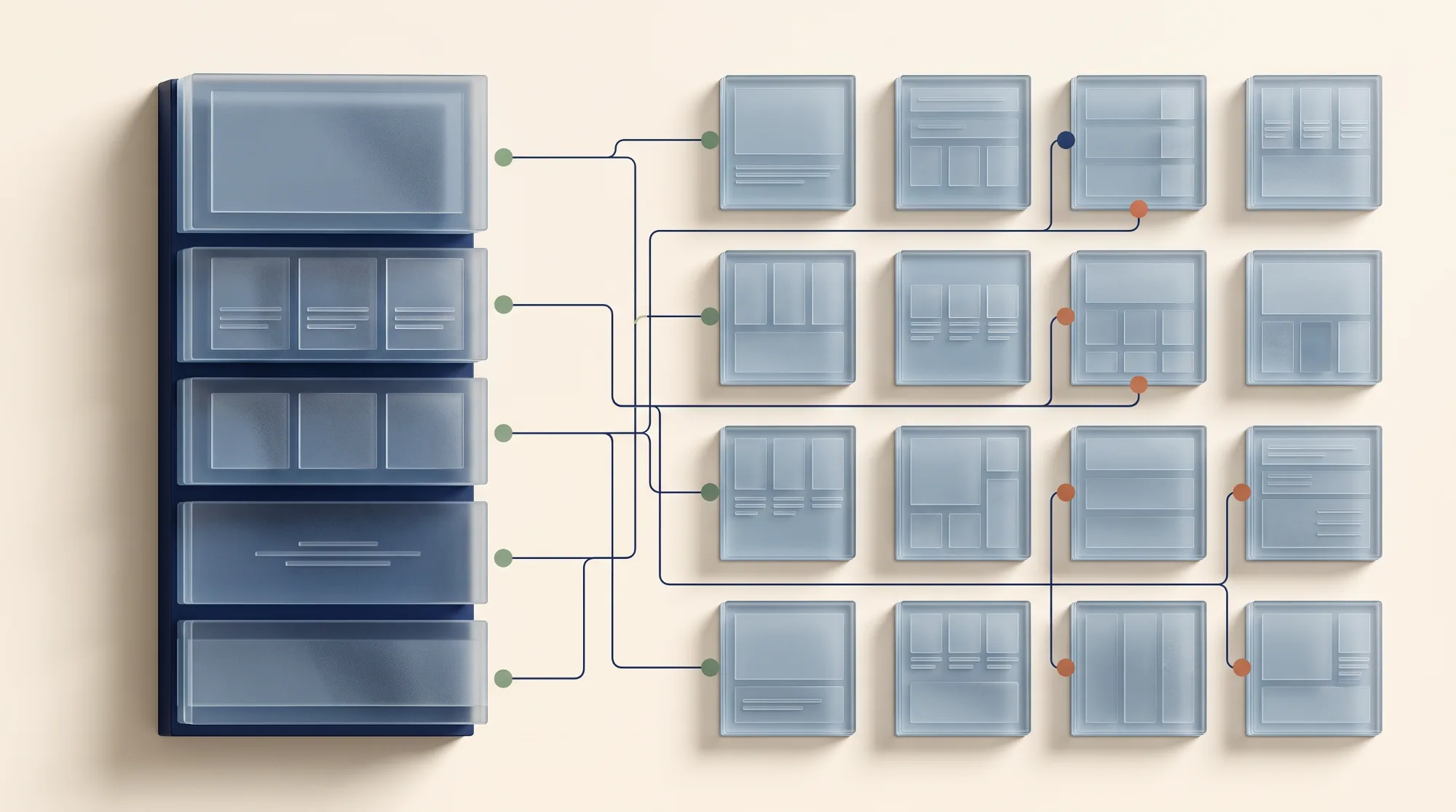
Because the website was to be developed using a WordPress theme, we needed a controlled and reusable system. I created a content matrix connecting page types, content requirements, available theme modules, business areas, SEO opportunities, and accessibility requirements.
Instead of creating one bespoke layout for every page, we designed a system in which each page could be assembled from a controlled selection of modules, within a maximum of 16 templates.
Removing duplication and improving findability
I reworked the information architecture to remove unnecessary duplicates, consolidate related content, reduce transitional pages, and clarify parent-child relationships.
Services and sectors were given more meaningful locations, making the relationship between group-level and company-level content easier to understand for users and for the internal team.
Integrating SEO into the structure
The new website was planned to support SEO-oriented content from the beginning: clear service pages, sector-specific content, destination and logistics pages, news and blog content, and search-friendly page hierarchies.
The objective was not simply to migrate existing pages, but to improve the quality and organisation of the content being migrated and created.
Coordinating development, then UAT
Development was managed by an external supplier. I clarified requirements, checked that the selected theme could support the intended structure, and resolved open questions on accessibility, mobile, SEO, search, multilingual content, and forms.
I then managed the User Acceptance Testing phase, reviewing the main journeys and templates, collecting issues, and coordinating fixes until the website was ready to go live.
The Solution: A Website Built as a Flexible Content System
One group structure, clearly communicated
The information architecture created a clearer relationship between the group and its individual companies. Users could understand the organisation at a higher level while still accessing specific services, business areas, and contact paths.
Reusable templates instead of one-off pages
The content matrix limited the number of templates while preserving flexibility. Each page could be built from modules supported by the selected WordPress theme, reducing design and development effort and making future updates more manageable.
Services and sectors with clearer roles
Services and sectors were reorganised according to how users might search for information. Existing areas were retained where still relevant, while new or more strategic topics were added.
A more useful contact experience
A unified contact form with optional fields for the relevant company, national or international requests, and the type of enquiry. One form supporting multiple business areas without forcing every user through the same path.
Content designed to grow
The new structure created space for news, blog articles, SEO-oriented updates, careers content, newsletter subscriptions, and downloadable resources. The website was treated as an evolving platform rather than a one-time collection of static pages.
Outcome: A Clearer Website, Successfully Taken Live
The redesigned website was brought through to launch.
The project delivered
- A clearer information architecture, with fewer duplicated pages and content paths.
- A more understandable relationship between the group’s companies.
- A reusable system based on a defined set of templates, aligned with WordPress modules.
- A structure prepared for SEO-oriented content and more coherent service navigation.
- A live website ready to evolve over time.
The visual design and copy were produced by the internal UI and content team, while I focused on the architecture, system definition, supplier coordination, and validation of the implemented experience.
The result was a website structure that made a complex logistics group easier to understand, maintain, and grow.
What This Taught Me: Constraints Can Create Better Systems
Working with a WordPress theme meant accepting constraints from the beginning. The project did not allow every page to become a completely custom design; instead, it required us to understand the available modules and use them strategically. That constraint became an opportunity to create a more consistent and sustainable system.
The most valuable lesson was that information architecture is not only about organising content for users. It also has to support the people who maintain the website, the teams who create new content, and the developers who implement the system.
A good website does not need infinite page types. It needs a clear structure that can carry many meaningful stories without repeating itself.
Have a complex organisation that needs a clearer digital structure?
Let’s turn scattered content into a website system that can grow with the business.